
Research from Cambridge and Edinburgh Universities Confirms: ECP Education Drives Immediate, Real-World Dietary Change
ATLANTA, GA — A new series of independent studies conducted by researchers at the University of Cambridge and the University of Edinburgh has confirmed that the Educated Choices Program’s (ECP) educational videos are a highly effective tool for shifting student behavior toward sustainable, plant-forward food choices.
The research, which moved beyond self-reported intentions to track actual consumer decisions, reveals that ECP’s curriculum significantly alters real-world actions, offering a cost-effective solution to mounting environmental concerns.
Key Findings: “The 2.5x Effect"
In a study conducted at the University of Edinburgh, researchers tracked the actual meal choices of students at a local café in the weeks following exposure to one of ECP’s videos on the environmental impact of food choices.
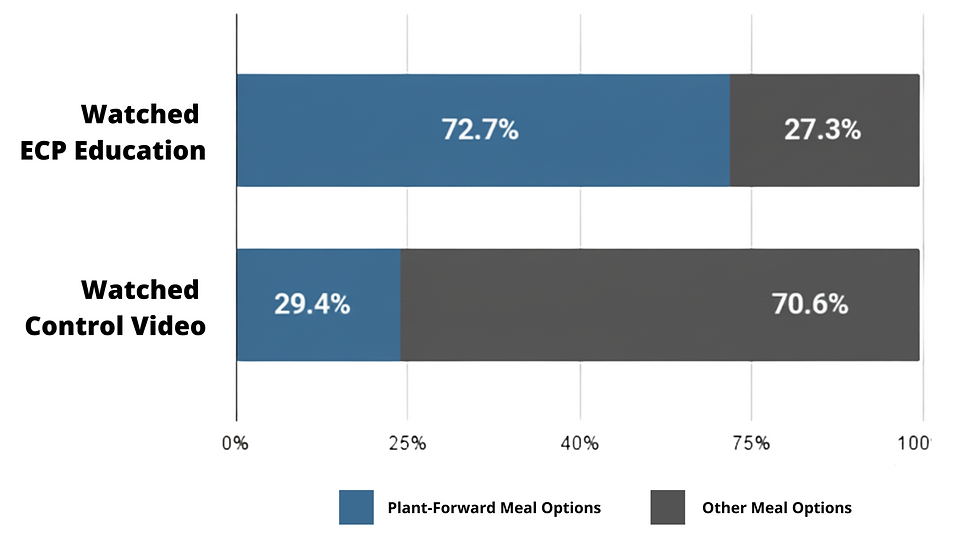
Major Shift in Behavior: Students who viewed the ECP video were 2.5 times more likely to choose a plant-forward meal compared to those in the control group.
Reversing Norms: While only 29% of the control group selected a plant-forward option, a staggering 73% of the ECP-informed group did, a near-perfect reversal in dining decisions.
Significant Changes, Even in Social Settings
A second study at the University of Cambridge tested the curriculum's influence days later in a high-stakes social setting: a formal three-course university dinner. Even without knowing the menu in advance, students who viewed ECP materials were significantly more likely to proactively request a plant-based meal, while 0% of the control group did the same. This demonstrates that ECP’s education is powerful enough to shift student behavior even against entrenched social and dining norms.
Education: A Cost-Effective Climate Solution
The research also highlighted the economic efficiency of ECP’s model. Researchers noted that the cost of mitigating one ton of CO2 through this form of educational intervention is significantly lower than the government's estimated social cost of carbon, making it one of the most scalable and financially viable tools for climate action available today.
"For more than a decade, we have watched students express a desire to make better choices, and now this rigorous academic validation shows that our education sparks immediate, measurable action," said Lorena Mucke, ECP’s CEO and Founder. "These results highlight something profound. When people truly understand the impact of our current food systems, they recognize their power to shape a healthier, more sustainable future. This is how change begins, one informed decision at a time.""
About Educated Choices Program (ECP)
The Educated Choices Program is an award-winning 501(c)(3) nonprofit organization that provides free food literacy education to equip students and community members with critical knowledge to improve human and planetary health. Its educational packages have been viewed by more than 3.7 million people across seventy countries and territories. Learn more at www.ecprogram.org.
Published in the journal Psychology of Human Animal Intergroup Relations, the peer-reviewed study “Educational Presentations Reduce Meat Consumption Across Two Universities” can be accessed here: https://phair.psychopen.eu/index.php/phair/article/view/18523


Comments