
Researchers at Cambridge and Edinburgh Confirm: ECP’s Education is a Cost-Effective, High-Impact Solution for Driving Real Change
We are thrilled to share the results of a groundbreaking new study conducted by researchers at the University of Edinburgh and the University of Cambridge. This experiment put the Educated Choices Program’s (ECP) curriculum to the test, and the results are nothing short of extraordinary.
For everyone who has ever wondered, "Does education really change behavior?" we now have a resounding “YES.”
The Study: Real Action, Not Just Intentions
Many impact studies measure “intentions,” asking students if they plan to eat differently. While more than 90% of ECP’s viewers report the intent to make more positive food choices, this study went much further. Researchers tracked actual, real-world food choices made by students after watching ECP’s educational videos.
The research was conducted over two separate studies at prestigious universities in the United Kingdom:
Study 1: The 2.5x Effect
At the University of Edinburgh, students were divided into two groups. One group watched an ECP video on the environmental impact of food choices, while the control group watched a video on renewable energy.
The result? Students who watched the ECP video were 2.5 times more likely to choose a more sustainable, plant-forward meal at a local café in the weeks following the presentation.
Control Group: Only 29% chose the plant-forward option.
ECP Group: A staggering 73% chose the plant-forward option.
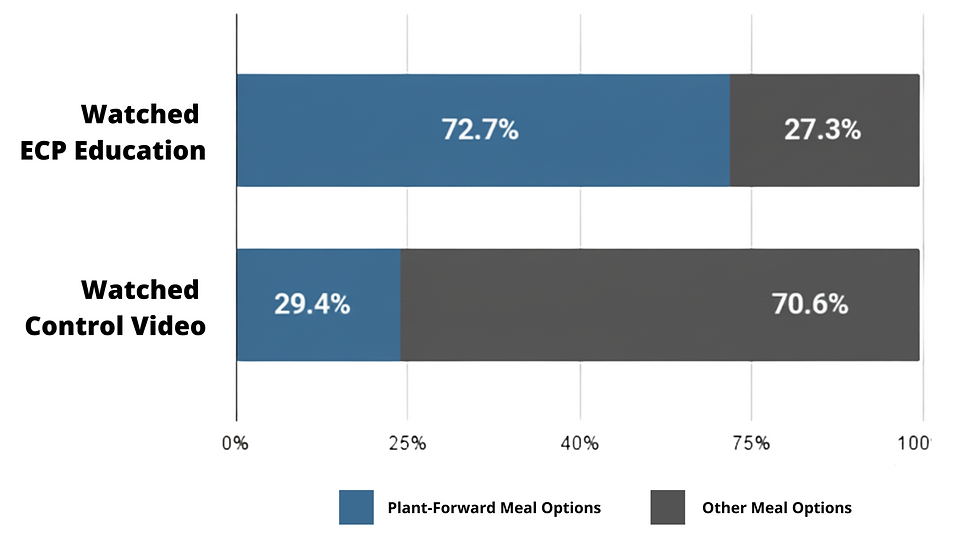
The researchers noted that the meal choices between the two groups were "nearly perfectly reversed," highlighting the significant impact of the video on the students' actions.
Study 2: Shifting the Norm
In a second study at the University of Cambridge, researchers tested the same environmental video along with one of ECP's society-focused videos against a control group. Students were offered a free ticket to a formal three-course university dinner and asked to make their meal choice days later.
Even in a high-stakes, formal social setting, and without knowing the actual meal they would be served, the impact remained clear: 0% of the control group chose a plant-based meal, while a significant portion (~20%) of the students who viewed ECP materials proactively selected the plant-based option for their formal dinner.
Why This Matters for Our Educators (and Donors)
This research proves that ECP isn't just providing free education; we are providing a catalyst for immediate, measurable behavioral change.
For Educators: This study confirms that students are hungry for this information. When presented with the facts about our food system, they don't just listen, they act. Our short videos are powerful enough to shift the dietary choices of the next generation of leaders.
For Donors: Your support is directly translating into more sustainable decisions and a lower carbon footprint. This study highlights that educational interventions are among the most cost-effective ways to combat climate concerns, with researchers noting that the cost of cutting a ton of CO2 through education is significantly lower than the government's estimated social cost of carbon.
The Power of Informed Choice
The researchers concluded that these brief, targeted video interventions are a "powerful tool” for promoting sustainable and plant-forward food choices.
At the Educated Choices Program, we believe that when people know better, they do better. Thanks to the rigorous work of researchers at Edinburgh and Cambridge, we now have the data to prove it.
Want to help us bring this life-changing education to more classrooms?
Access our free videos, lesson plans, and more with an account on educatedchoices.org.
Donate to help us reach even more students worldwide at ecprogram.org/donate.
About Educated Choices Program (ECP)
The Educated Choices Program is an award-winning 501(c)(3) nonprofit organization that provides free food literacy education to equip students and community members with critical knowledge to improve human and planetary health. Its educational packages have been viewed by more than 3.7 million people across seventy countries and territories. Learn more at www.ecprogram.org.
Published in the journal Psychology of Human Animal Intergroup Relations, the peer-reviewed study “Educational Presentations Reduce Meat Consumption Across Two Universities” can be accessed here: https://phair.psychopen.eu/index.php/phair/article/view/18523


Comments